


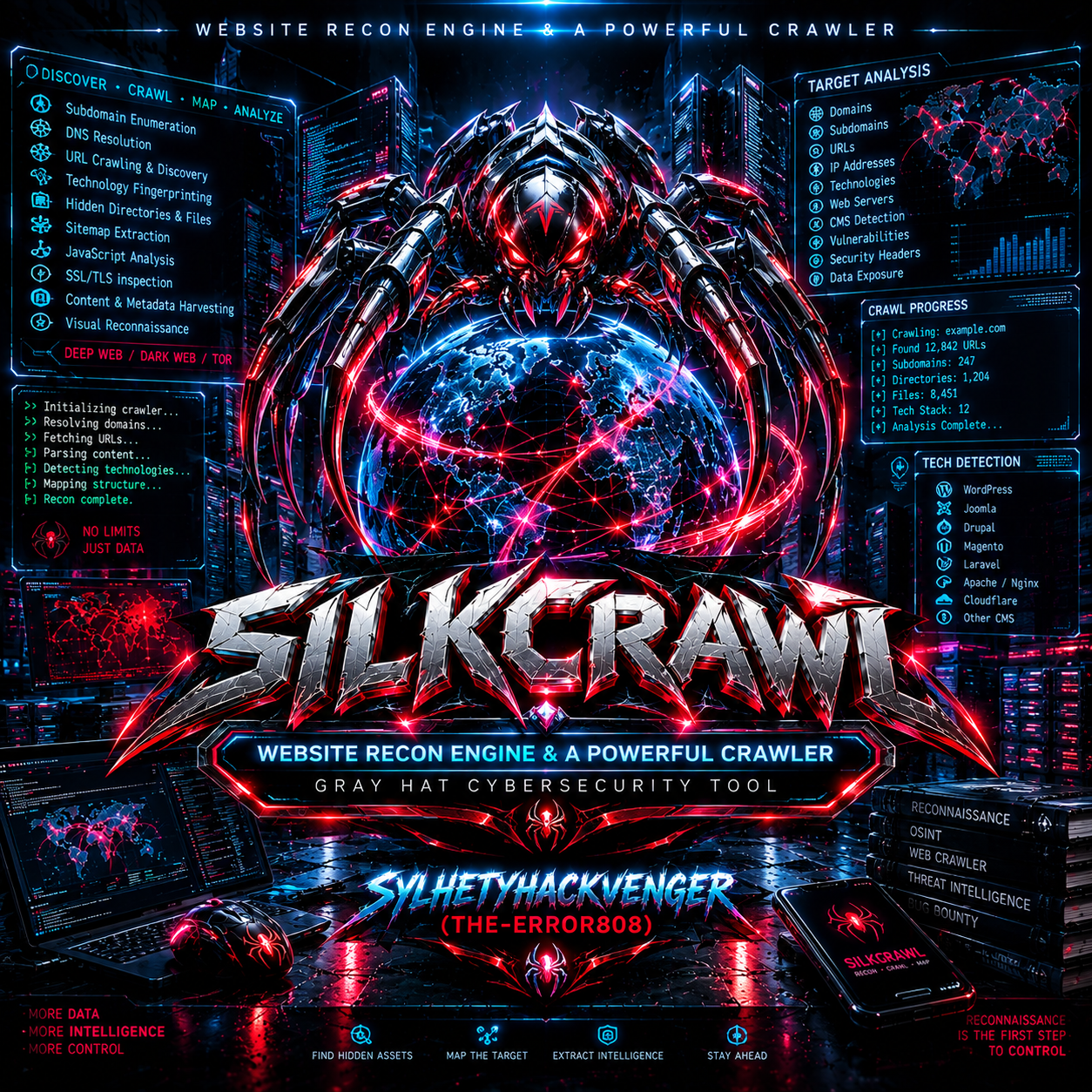

SILKFANG: The Next-Generation Website Reconnaissance Engine — Deep Crawling, Attack-Surface Intelligence & Security Analysis
A powerful web reconnaissance platform engineered to transform complex website surfaces into actionable security intelligence.
Project: SILKFANG
Category: Website Reconnaissance | Attack-Surface Intelligence | Security Research
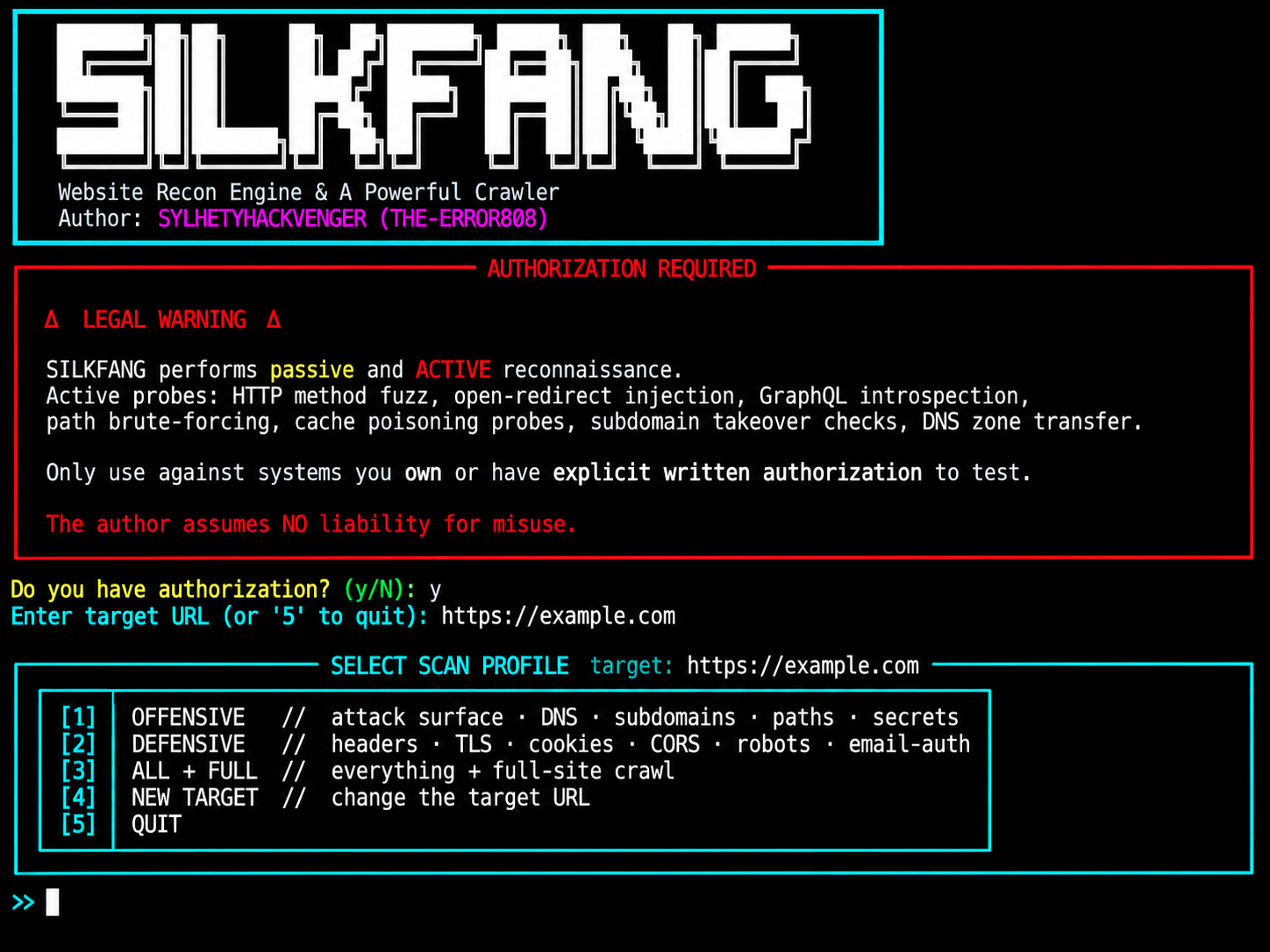
Language: Python 3.9+
Author: SYLHETYHACKVENGER (THE-ERROR808)
GitHub: https://github.com/sylhetyhackvenger/Silkfang
License: MIT
—
1. Introduction — Beyond Traditional Website Crawling
Modern websites are complex ecosystems. A single application can contain hundreds of pages, JavaScript modules, API endpoints, external services, cloud integrations, authentication components, and third-party technologies.
Understanding that environment requires more than a conventional link crawler.
SILKFANG is designed to bring these discovery and analysis activities together in one asynchronous reconnaissance engine. It crawls website resources, examines HTML and JavaScript, identifies technology fingerprints, analyzes security configurations, correlates infrastructure information, and streams findings as they are discovered.
Its central philosophy is simple:
Discover the surface. Understand the technology. Correlate the evidence. Reveal the security picture.
Rather than presenting reconnaissance as a collection of disconnected tasks, SILKFANG organizes multiple research capabilities into a unified workflow.
2. What Makes SILKFANG Stand Out?
SILKFANG brings together several important areas of website security research:
– Deep website crawling and resource discovery.
– HTML, JavaScript, CSS, and JSON intelligence.
– Technology-stack fingerprinting.
– Publicly exposed secret-pattern detection.
– DNS and subdomain intelligence.
– TLS certificate analysis.
– Security-header and cookie auditing.
– CORS and CSP configuration analysis.
– WAF and CDN identification.
– Asset metadata analysis.
– Live severity-classified reporting.
– JSONL and SARIF integration.
– Checkpoint recovery and baseline comparison.
The project documentation describes more than 40 secret-provider families, 35+ JavaScript library fingerprints, 25+ WAF fingerprints, and extensive subdomain and cloud-provider signature collections. <Cite refs={[“turn380154view0″,”turn802883view2″,”turn802883view3”]}/>
3. Architecture — Inside the SILKFANG Engine
SILKFANG is built around an asynchronous crawler and a collection of specialized analysis handlers.
Architecture diagram
SILKFANG ENGINE
|
CLI / INTERACTIVE UI
|
CRAWLER CORE
|
+———-+———-+
| | |
URL Queue Scope Layer Workers
| | |
+———-+———-+
|
FETCHING ENGINE
|
+———-+———-+
| | |
HTML HTTP DNS
| | |
+———-+———-+
|
ANALYSIS PIPELINE
|
+—————–+—————–+
| | |
JS / JSON Technology Security
Extraction Fingerprinting Auditing
| | |
+—————–+—————–+
|
INTELLIGENCE ENGINE
|
+—————–+—————–+
| | |
Secret Patterns Asset Analysis TLS / CORS
| | |
+—————–+—————–+
|
FINDING CORRELATION
|
LIVE STREAM ENGINE
|
+———+———+
| | |
TXT JSONL SARIF
| | |
+———+———+
|
CHECKPOINT / BASELINE
The README presents a crawler core, fetcher, handler pipeline, active-probe layer, live-stream engine, and reporting system. <Cite refs={[“turn380154view0″,”turn802883view0”]}/>
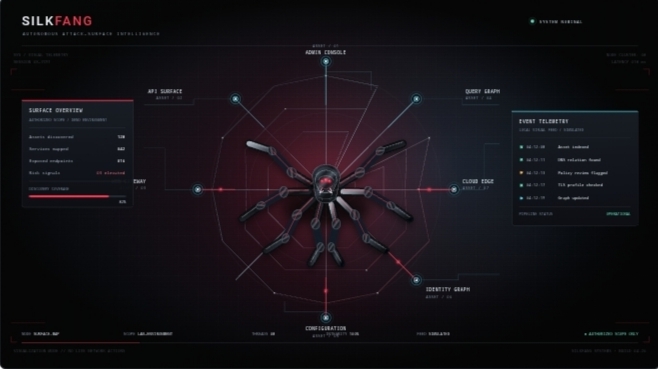

3.1 Crawler Core
The crawler coordinates URL discovery, page processing, worker execution, and scope enforcement.
Its asynchronous design allows multiple independent resources to be processed without requiring every request to complete sequentially.
3.2 Fetching Engine
SILKFANG documents support for “curl_cffi” and “httpx” as HTTP fetching options.
The project also uses BeautifulSoup and lxml for HTML parsing. These components form the foundation for collecting and processing web resources. <Cite refs={[“turn802883view0″,”turn540534view0”]}/>
3.3 Specialized Handler Pipeline
Different resource types are routed through corresponding analysis components:
– HTML extraction.
– JavaScript analysis.
– JSON inspection.
– CSS resource discovery.
– Security configuration analysis.
– Asset metadata processing.
This modular structure makes the overall system easier to understand and extend.
3.4 LiveStream Engine
One of SILKFANG’s most distinctive presentation features is its live reporting engine.
The README describes a system that:
1. Deduplicates repeated findings.
2. Assigns severity classifications.
3. Applies terminal color formatting.
4. Streams discoveries as they occur.
5. Maintains finding counts.
Instead of waiting until the end of a lengthy crawl, researchers can follow the discovery process through a continuously updated terminal interface. <Cite refs={[“turn802883view1”]}/>
4. Three Integrated Scan Profiles
SILKFANG documents three scan profiles, each designed around a different assessment objective.
Profile 1 — OFFENSIVE
<badge color=”warning”>Authorized assessment only</badge>
This profile is intended for authorized attack-surface mapping and security research.
Its documented analysis areas include:
– Website and resource discovery.
– Technology-stack identification.
– JavaScript endpoint and secret-pattern analysis.
– Subdomain intelligence.
– Sensitive-resource exposure assessment.
– HTTP behavior analysis.
– GraphQL configuration assessment.
– Redirect and caching behavior analysis.
– DNS and infrastructure checks.
Profile 2 — DEFENSIVE
<badge color=”success”>Configuration security</badge>
This profile focuses on understanding and improving a website’s security posture.
Its documented capabilities include:
– Security-header auditing.
– HSTS configuration review.
– Content Security Policy analysis.
– Cookie security-attribute inspection.
– CORS configuration assessment.
– TLS certificate and cipher inspection.
– Form and CSRF-token presence analysis.
– Public security-document discovery.
– Server-information exposure analysis.
Profile 3 — ALL
The combined profile brings together the project’s documented reconnaissance and defensive analysis capabilities.
It provides a consolidated view of website resources, technology fingerprints, configuration observations, and security-related findings.
The three profiles and their documented functions are described in the project README. <Cite refs={[“turn802883view0″,”turn802883view5”]}/>
5. Deep JavaScript Intelligence
Modern applications frequently expose important architectural information through their frontend code.
SILKFANG includes a dedicated JavaScript analysis pipeline designed to inspect publicly available scripts.
Its documented analysis areas include:
– JavaScript AST parsing through Esprima.
– Endpoint and URL discovery.
– Dynamic import identification.
– WebSocket URL discovery.
– Source-map reference detection.
– Fetch and Axios endpoint extraction.
– JWT structure inspection.
– “postMessage” origin-check analysis.
– DOM source-and-sink pattern correlation.
– Sensitive browser-storage key identification.
– Prototype-pollution pattern recognition.
This gives researchers a broader picture of how an application’s frontend communicates with its backend and external services. <Cite refs={[“turn802883view2”]}/>
6. Secret Detection Intelligence
SILKFANG contains a signature-based secret detection engine.
The README documents 44 provider families and more than 60 regular-expression signatures.
The provider categories include cloud services, payment platforms, source-control providers, communication services, AI platforms, monitoring systems, and developer infrastructure.
The detection engine also documents:
– High-entropy string analysis.
– Credit-card number validation using the Luhn algorithm.
– IBAN pattern validation.
– Private-key and certificate detection.
– Sensitive JSON-key inspection.
– Token-like data identification.
These capabilities are valuable for authorized exposure reviews, especially when development assets unintentionally contain sensitive configuration.
Responsible handling matters: A detected credential or token should be treated as confidential evidence. It should be redacted in public reports and handled through the organization’s approved security-response process. <Cite refs={[“turn380154view0″,”turn802883view2”]}/>
7. Technology Stack Fingerprinting
Understanding the technologies behind an application is an important part of security assessment.
SILKFANG documents identification of:
– Web servers.
– Frameworks.
– Content delivery networks.
– Web application firewalls.
– Authentication providers.
– Analytics platforms.
– Payment integrations.
– JavaScript libraries.
– Cloud infrastructure indicators.
– Error-monitoring services.
Its library-version detection collection covers more than 35 JavaScript libraries, according to the README.
This information helps security teams organize their technology inventory and prioritize component maintenance. <Cite refs={[“turn380154view0″,”turn802883view2”]}/>
8. DNS, Subdomain & Infrastructure Intelligence
SILKFANG includes a dedicated DNS and subdomain analysis layer.
The README describes collection and analysis of:
– A and AAAA records.
– NS and MX records.
– TXT and CAA records.
– SOA and PTR records.
– DNSKEY and TLSA records.
– SPF, DKIM, and DMARC.
– MTA-STS and SMTP TLS.
– RDAP and ASN information.
– Certificate-transparency-based subdomain discovery.
– Public passive-DNS sources.
– CNAME configuration and provider fingerprints.
The project also documents subdomain-takeover and dangling-CNAME validation features for authorized assessments.
Together, these capabilities help researchers understand how public-facing web infrastructure is organized. <Cite refs={[“turn802883view3″,”turn380154view0”]}/>
9. TLS, Headers, Cookies & CORS Analysis
Security configuration is often just as important as application functionality.
SILKFANG includes a broad defensive auditing component.
TLS Analysis
Documented information includes:
– TLS protocol version.
– Cipher-suite information.
– Certificate issuer.
– Certificate subject.
– Expiration information.
– Subject Alternative Names.
Security Headers
The README describes analysis of more than 30 security-header categories, including:

– Strict-Transport-Security.
– Content-Security-Policy.
– X-Frame-Options.
– X-Content-Type-Options.
– Referrer-Policy.
– Permissions-Policy.
– Cross-Origin-Opener-Policy.
– Cross-Origin-Embedder-Policy.
Cookie Security
The project inspects:
– Secure.
– HttpOnly.
– SameSite.
– Domain and Path.
– “__Host-” and “__Secure-” prefixes.
CORS
The documented CORS analysis covers wildcard origins, credential-related configuration, origin reflection, and preflight behavior.
These findings can help development teams identify configuration weaknesses and strengthen application security. <Cite refs={[“turn380154view0″,”turn802883view3”]}/>
10. WAF & CDN Fingerprinting
SILKFANG contains a WAF signature collection covering more than 25 documented providers.
The README lists technologies and services associated with Cloudflare, Akamai, AWS, Fastly, Imperva, F5, Sucuri, and others.
It also documents detection of bot-challenge indicators.
This component helps researchers understand the protective infrastructure positioned in front of a website. <Cite refs={[“turn802883view3”]}/>
11. Asset Intelligence
Website security research often extends beyond HTML pages.
SILKFANG includes a deeper asset-analysis component covering:
– Image EXIF metadata.
– PDF document metadata.
– Office document metadata.
– ZIP and TAR archive information.
– SVG embedded-content inspection.
– Font metadata.
This helps build a more complete picture of publicly exposed website resources.
12. Reporting & Intelligence Export
SILKFANG offers several reporting mechanisms.
Format| Purpose
TXT| Human-readable findings
JSONL| Structured event streaming
SARIF 2.1.0| Security-tool and CI/CD integration
Baseline diff| Change tracking
Checkpoint JSONL| Session recovery
SARIF Integration
SARIF support is especially useful for development teams that want security findings to appear within an established code-security workflow.
The README describes integration with GitHub Advanced Security through a CI/CD workflow.
Baseline Comparison
The baseline feature compares current findings with a previous report and highlights changes.
This is useful for tracking newly introduced observations during recurring authorized security reviews.
Resume System
The checkpoint mechanism is designed to preserve crawl progress and findings so an interrupted session can continue later. <Cite refs={[“turn540534view1″,”turn802883view1”]}/>
13. Technology Stack
The repository documents the following major dependencies:
Technology| Role
Python 3.9+| Core application
asyncio| Asynchronous execution
curl_cffi| HTTP fetching
httpx| HTTP fallback
BeautifulSoup| HTML parsing
lxml| Document parsing
tldextract| Domain identification
Rich| Terminal interface
Esprima| JavaScript AST parsing
dnspython| DNS analysis
Pillow| Image metadata
pypdf| PDF metadata
fonttools| Font metadata
ipwhois| RDAP and ASN information
uvloop| Optional event-loop optimization
The repository also includes “requirements.txt” for dependency installation. <Cite refs={[“turn802883view0″,”turn540534view0”]}/>
14. Source Code & Repository Structure
The public repository contains:
Silkfang/
│
├── assets/
│
├── LICENSE
│
├── README.md
│
├── requirements.txt
│
└── silkfang.py
The main Python source file is approximately 3,869 lines long, with around 163 KB of source content according to GitHub’s file metadata.
The project uses a substantial single-file implementation with dedicated functions and data collections for crawling, extraction, fingerprinting, analysis, and reporting. <Cite refs={[“turn380154view0″,”turn373255view1”]}/>
15. Scope, Authorization & Responsible Research
SILKFANG is designed for security research and authorized assessment.
The README explicitly requires ownership or written authorization before using the tool against a target. It also documents hostname scope and crawl-scope controls.
For responsible use:
– Assess only systems covered by explicit authorization.
– Keep the assessment scope documented.
– Use the defensive and passive analysis capabilities where appropriate.
– Protect session data and discovered secrets.
– Avoid publishing sensitive findings.
– Coordinate disclosure with the responsible organization.
– Review the effect of active assessment features before any approved engagement.
A well-organized security assessment combines technical capability with clear authorization and careful evidence handling. <Cite refs={[“turn380154view0″,”turn540534view1″,”turn540534view0”]}/>
16. Open-Source License
SILKFANG is published under the MIT License.
Author: SYLHETYHACKVENGER (THE-ERROR808)
The license file in the repository is the authoritative source for redistribution and reuse terms.
17. Why SILKFANG Deserves Attention
SILKFANG brings together a wide range of website-reconnaissance and defensive-analysis concepts in a single Python project.
Its most compelling strengths are:
1. Broad coverage: Website crawling, frontend analysis, infrastructure intelligence, and configuration auditing.
2. Deep inspection: Dedicated HTML, JavaScript, JSON, CSS, and asset-analysis components.
3. Live visibility: Findings are streamed and categorized as the engine processes resources.
4. Structured output: JSONL and SARIF support make the results easier to integrate into other workflows.
5. Research flexibility: Separate assessment profiles organize different security objectives.
6. Extensible signatures: The documented architecture supports extending detection patterns and analysis handlers.
7. Workflow continuity: Checkpoints and baseline comparison support recurring research.
18. Final Verdict
SILKFANG is built around a powerful idea: bring the major layers of website reconnaissance into one coherent intelligence workflow.
From deep crawling and JavaScript analysis to technology fingerprinting, DNS intelligence, TLS inspection, and structured security reporting, the project presents an ambitious collection of capabilities for the modern web-security research environment.
Its live-streaming interface gives the project a distinctive identity, while its reporting and baseline features connect reconnaissance with ongoing security assessment.
For security researchers, developers, and authorized assessment teams interested in understanding the web attack surface, SILKFANG is a project worth exploring.
Discover the surface. Read the evidence. Understand the architecture. Strengthen the security.
Explore SILKFANG
GitHub Repository:
https://github.com/sylhetyhackvenger/Silkfang
README:
https://github.com/sylhetyhackvenger/Silkfang/blob/main/README.md
Main Source:
https://github.com/sylhetyhackvenger/Silkfang/blob/main/silkfang.py
Dependencies:
https://github.com/sylhetyhackvenger/Silkfang/blob/main/requirements.txt
License:
https://github.com/sylhetyhackvenger/Silkfang/blob/main/LICENSE
—
SILKFANG — SILENT. SHARP. PRECISE.
Created by SYLHETYHACKVENGER (THE-ERROR808)
Explore the project, review its source, and use its capabilities responsibly within authorized security research.